
She Wasn’t a Nurse, and It Wasn’t Botox. Now She’s Going to Federal Prison.
By Kate Dee, MD — Founder, MedSpa Board
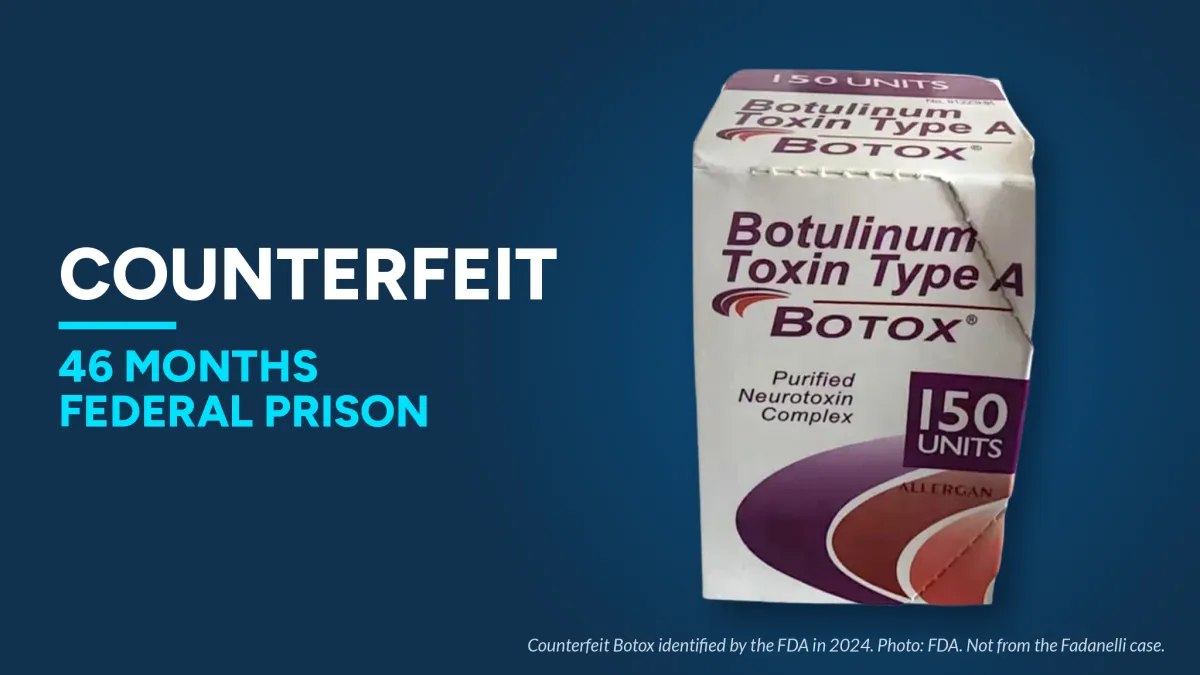
On September 2, 2026, a federal judge in Boston sentenced Rebecca Fadanelli, 40, of Stoughton, Massachusetts, to 46 months in prison. Fadanelli owned Skin Beaute Med Spa, with locations in Randolph and South Easton. Between March 2021 and June 2024, she performed more than 2,700 Botox and dermal filler procedures on more than 900 clients and collected over $1 million doing it.
She was not a doctor. She was not a Nurse Practitioner with independent practice authority. She was not even licensed as a nurse. The products were not Botox, Sculptra, Restylane, or Juvéderm. They were counterfeits imported from China and Brazil. Several of her clients were hospitalized.
Unfortunately this case is not unusual. The multitude of med spas operating with fake credentials and fake products is a behemoth that law enforcement has watched grow and only recently decided to pay attention to. Meanwhile legitimate medspas get lumped in with this sordid mess and consumers have no way to tell the difference.
A note on sourcing. Everything below comes from the U.S. Attorney’s Office for the District of Massachusetts and published news coverage of the case. Fadanelli pleaded guilty, so these are not allegations.
What happened
Fadanelli was a licensed aesthetician. In Massachusetts, as in every state, that license does not permit injecting prescription drugs or devices. (Even if she had been licensed as a nurse, it would still have been a felony to practice medicine unsupervised). According to federal prosecutors, she “falsely represented to clients and employees that she was a licensed nurse” and told clients she was “using authentic Botox and FDA-approved dermal fillers such as Sculptra, Restylane and Juvéderm.”
The products came in through international shipments to her home and business. When federal authorities began seizing those shipments and notified her that the products were misbranded and unapproved, she did not stop. Prosecutors say she “directed suppliers to use different delivery addresses and other individuals’ names as recipients in an effort to avoid additional seizures.”
Investigators searched her businesses in June 2024. She was arrested on November 1, 2024. In May 2025, while on pretrial release, she performed another injection at her home, using an unknown substance the client reportedly believed was Sculptra. Her release was revoked, and she has been in custody since November 2025. She pleaded guilty in April 2026 to four counts of importing merchandise contrary to law, two counts of selling or dispensing a counterfeit drug, and two counts of selling or dispensing a counterfeit device.
In addition to the 46 months, Judge Julia E. Kobick ordered two years of supervised release, $1,001,562 in restitution, and forfeiture of the same amount.
U.S. Attorney Leah B. Foley put it this way: “This was not a mistake or a one-time lapse in judgment. Rebecca Fadanelli built a business on deception and repeatedly put profit ahead of the health and safety of the people who trusted her.”
What it did to patients
The injuries described in the sentencing release include severe swelling, infections, facial drooping and paralysis, double vision, impaired eyesight, and hard lumps under the skin. One client was hospitalized for weeks with severe facial swelling, headaches, weakness, and fever-like symptoms. Another spent four days in the hospital with facial drooping, paralysis, double vision, and headaches. One had impaired vision for three months. One needed corrective surgery to remove hard lumps and was left with scarring.
Investigators also found that bacteriostatic water recovered during the June 2024 search was contaminated with Methylobacterium, a bacterium capable of causing infection. That detail matters. It means the risk was not only in the counterfeit vials, but in the basic handling of everything that went into a syringe.
Why counterfeit is a medical problem, not a paperwork problem
Authentic botulinum toxin is a biologic made under tightly controlled conditions, dosed in units that are standardized for that specific product. A counterfeit vial can contain too much toxin, too little, a different toxin, or none at all, and nothing on the label will tell you which. Too much, or toxin that spreads beyond the injection site, can produce the drooping, double vision, and weakness these patients described. In a more severe case, it can affect swallowing and breathing. On top of that a counterfeit source could be contaminated with bacteria or endotoxin and cause an immediate anaphylaxis or infection. Counterfeit sourcing has been a scourge in the industry not just because of people like Fadanelli. Unfortunately seeking the cheapest source for injectables is a rampant problem in the industry even among licensed providers.
This is not theoretical. In 2024 the CDC investigated harmful reactions linked to counterfeit or mishandled botulinum toxin injections. Its final count was 17 cases across 9 states, 13 of them hospitalized, in people who received injections from unlicensed providers or from products bought outside authorized channels. The CDC’s guidance from that investigation is one sentence long: “Only get botulinum toxin injections if the product is obtained from an authorized supplier and the provider is licensed and trained to give the injection.”
Fillers carry their own risk. A counterfeit filler is an unknown material with unknown sterility placed under the skin. Infection, nodules, and granulomas are the predictable result, and a hard lump from a product no one can identify is far harder to treat than a complication from a known one.
What legitimate legal compliance looks like
Every failure in this case has a direct counterpart in how a properly run medspa operates. There are three.
A real license. The person injecting holds an active license that permits them to inject in that state, whether as a physician, physician assistant, nurse practitioner, or registered nurse working under appropriate supervision. An aesthetician license is not that. The license can be looked up on the state board’s website in under a minute, and a legitimate practice expects patients to do so.
A real product. Toxins and fillers are purchased directly from the manufacturer, with invoices that match the lot numbers on the vials. Federal law requires providers to buy prescription drugs only from authorized sources, and the FDA has told clinicians to inspect each product for signs of counterfeiting before use. In its 2024 alert, the FDA noted that counterfeit Botox listed the active ingredient as “Botulinum Toxin Type A” rather than “OnabotulinumtoxinA,” carried non-English text on the carton, and came in a dose the manufacturer does not make. If a price looks far below what everyone else is charging, the product is usually the reason.
A real medical director. A licensed physician (or NP or PA in some states) is responsible for protocols, supervision, product sourcing, and the management of complications, and is reachable when something goes wrong. At Skin Beaute, clients who developed complications had no one in the chain of care qualified to recognize what was happening. They found out in the emergency room.
If you are a patient
Before your next injection, ask four questions. What is your license? (and look it up!) Who is your medical director? (Look them up too!) Where do you buy your products? May I see the box or vial before you draw it up? A legitimate provider will answer all four without hesitation. If the answer is a blank look, a story about a special supplier, or a price that seems too good, walk away.
If you have had an injection and develop drooping eyelids, blurred or double vision, difficulty swallowing or breathing, or muscle weakness, seek emergency care. Suspected counterfeit products can be reported to the FDA at 800-551-3989 or through MedWatch.
Where MedSpa Board certification fits
No certification can stop someone who is willing to lie about who they are and hide shipments from federal agents. That is what prosecutors are for, and in this case they did their job. What certification does is make the legitimate version of this business visible. The MedSpa Board will not certify a practice that cannot show us who is injecting and under what license, who its medical director is, and where every toxin and filler it uses was purchased, with documentation to match.
For owners doing it right, certification lets you prove it before a patient has to ask. For patients, it is the difference between hoping and knowing who is holding the needle and what is in it. Trust, verified. Safety, certified.
If you run a medspa and your standards are ready to be verified, begin your application at medspaboard.com/certification-application. If you want to see where you stand first, download the free checklist at certification-checklist.
— Kate Dee, MD
Sources & further reading
- U.S. Attorney’s Office, District of Massachusetts, “Med Spa Owner Sentenced to 46 Months in Prison for Performing Thousands of Counterfeit Botox and Filler Injections,” September 2026. https://www.justice.gov/usao-ma/pr/med-spa-owner-sentenced-46-months-prison-performing-thousands-counterfeit-botox-and
- U.S. Attorney’s Office, District of Massachusetts, “Med Spa Owner Pleads Guilty to Performing Thousands of Injections Using Counterfeit Products,” April 2026. https://www.justice.gov/usao-ma/pr/med-spa-owner-pleads-guilty-performing-thousands-injections-using-counterfeit-products
- U.S. Attorney’s Office, District of Massachusetts, “Spa Owner Arrested for Allegedly Performing Thousands of Illegal Counterfeit Injections on Clients,” November 2024. https://www.justice.gov/usao-ma/pr/spa-owner-arrested-allegedly-performing-thousands-illegal-counterfeit-injections-clients
- Boston.com, “Unlicensed South Shore med spa owner who gave fake Botox injections sentenced to 46 months in prison,” September 7, 2026. https://www.boston.com/news/crime/2026/09/07/unlicensed-south-shore-med-spa-owner-who-gave-fake-botox-injections-sentenced-to-46-months-in-prison/
- Centers for Disease Control and Prevention, “Harmful Reactions Linked to Counterfeit ‘Botox’ or Mishandled Botulinum Toxin Injections.” https://www.cdc.gov/botulism/outbreaks/harmful-reactions-botox-injections/index.html
- U.S. Food and Drug Administration, “Counterfeit Version of Botox Found in Multiple States,” April 16, 2024 (updated May 1, 2024). https://www.fda.gov/drugs/drug-safety-and-availability/counterfeit-version-botox-found-multiple-states
- Medspa Board, certification standards and application. https://medspaboard.com/certification-application/