
The FDA Just Flagged a Jeuveau Instagram Reel. Aesthetics and Wellness Centers Post Similar Claims Every Day.
By Kate Dee, MD — Founder, MedSpa Board
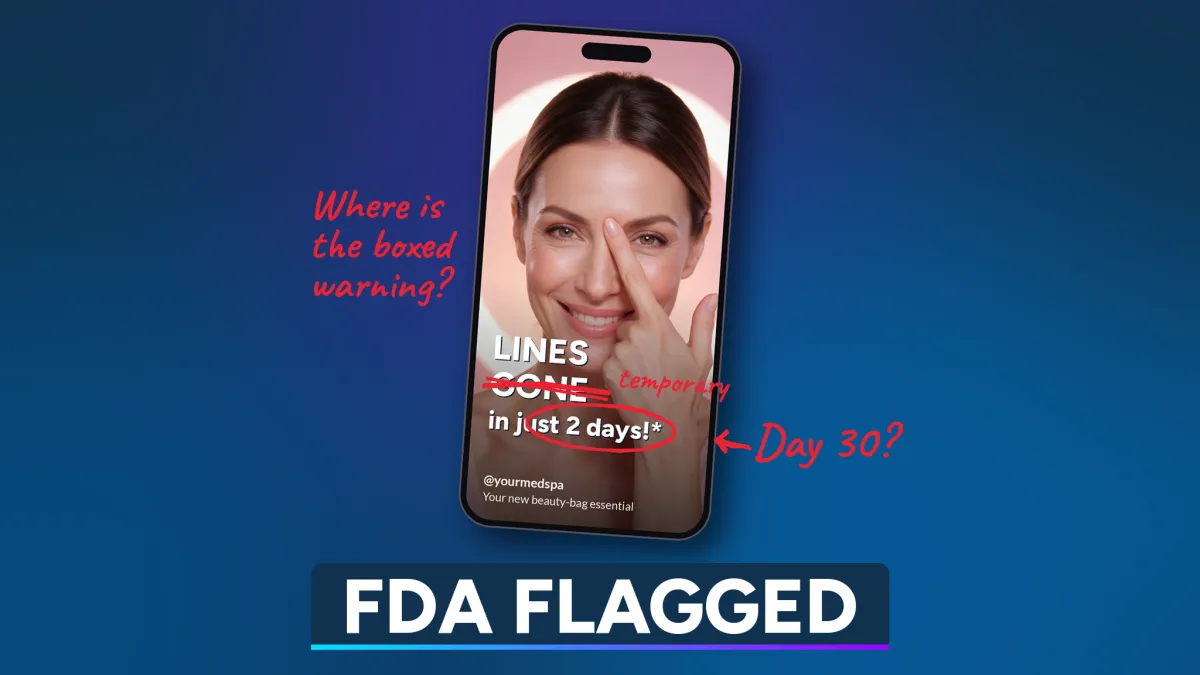
On September 28, 2026, the FDA’s Office of Prescription Drug Promotion sent an untitled letter to Evolus, the maker of Jeuveau, over a single Instagram reel. The reel ran on the company’s own accounts. It showed a patient at Day 0, Day 2, and Day 30, set to upbeat music, saying the line between her eyebrows was “gone.” The on-screen text read, “Lines today. Blurred in as little as 2 days.” The caption talked about “blurring the lines between what’s found in your beauty bag and what happens in the treatment room.”
The FDA’s conclusion: “the post misbrands Jeuveau within the meaning of the FD&C Act and makes its distribution violative.” In other words—claiming the drug eliminates wrinkles on day 2 is a false claim and illegal.
If that reel sounds familiar, it should. Some version of it goes up on medspa accounts all over the country every single day.
What the FDA objected to
Start with “gone.” Jeuveau is approved for “temporary improvement in the appearance of moderate to severe glabellar lines.” Improvement, and temporary. The FDA said claims suggesting that frown lines are “gone,” or that patients get “complete results,” are not supported.
Then the two days. The trials that got Jeuveau approved measured success at Day 30, and success meant at least a two-point improvement on the glabellar line scale, agreed on by both the investigator and the patient. The Day 2 number in the reel came from an exploratory analysis that counted a one-point change. The FDA called that “a much smaller level of improvement” and described the analysis as hypothesis generating. That is not proof of anything.
Then the beauty bag. Jeuveau is a prescription botulinum toxin with a boxed warning for distant spread of toxin effect. The FDA wrote that suggesting the lines are blurred between a prescription product and an over-the-counter cosmetic is “especially problematic from a public health perspective given the serious risks associated with the use of the product.”
The risk information did appear, but only at the end of the reel, “where it is unlikely to draw the viewer’s attention,” and in a caption the viewer had to scroll through.
And the testimonial did not save it. The FDA accepted that the patient may have described her own experience accurately. It still found that the testimonial “does not adequately support the suggestion that all patients taking Jeuveau will experience a similar response.” The post carried an “Individual results may vary” disclaimer. That did not fix it.
Evolus has 15 working days to respond and to list every other promotional piece making similar claims. The FDA also noted that it gave the company advisory comments on similar draft materials back in November 2019.
The rule: you may only advertise what the evidence supports
Two federal agencies police this, and between them they cover everyone.
The FDA regulates how drug companies promote prescription drugs. Claims have to be consistent with the approved labeling, backed by adequate evidence, and balanced with the risks. An untitled letter is the lower tier of FDA enforcement, below a warning letter. It is still a formal finding that a drug was misbranded.
The FTC covers everyone else who advertises a health product or service, and that includes medspas and wellness clinics. Its standard is that health claims require “competent and reliable scientific evidence,” and the evidence has to exist first: “Before disseminating an ad, advertisers must have adequate substantiation for all objective product claims conveyed, expressly or by implication.” Implied claims count. So do testimonials. In the FTC’s words, individual consumer experiences “are never sufficient to substantiate claims about the effects of a health product,” and testimonials reporting results more dramatic than people can generally expect “are likely to be deceptive.”
The FTC has used this against small operators. In 2018 it brought its first case against an IV therapy company, iV Bars, for claiming its drips could treat cancer, multiple sclerosis, and heart failure without the science to back it up. The agency says it has gone after individual owners, ad agencies, and expert endorsers too. On top of the federal rules, state licensing boards and state consumer protection laws prohibit false or misleading advertising by licensed providers.
This is not only the manufacturers
Evolus has a regulatory affairs department and still posted this. Most medspas have a front desk employee or an outside marketing agency running the Instagram account, and nobody with a license reads the post before it goes up.
The results are everywhere. Lines erased. Results overnight. No downtime, no risk. Botox sold next to lip gloss in a “beauty essentials” carousel. Neurotoxin specials with no mention that these are prescription drugs. Exosomes that “regenerate.” IV drips that “boost immunity.” Peptides that “heal.” Glowing testimonials standing in for data that does not exist.
Licensed, well-meaning practices do this too. Being a legitimate medical practice does not make the claim true, and it does not make the post legal. The practice and its licensed providers answer for what the account says.
What legal compliance looks like
Advertised claims must be evidence-based. Describe a drug by its approved indication, and describe onset and duration the way the prescribing information does.
The evidence comes first. If you cannot point to the study that supports a claim, do not post the claim. Be especially careful not to make claims in your advertising that you heard from a rep. Make sure there is actual evidence to back that claim up.
Testimonials and before-and-after photos show what patients can typically expect, not your single best result.
Risk information is in the post where people will see it. A prescription drug with a boxed warning is presented as one.
A licensed clinician reviews marketing before it is published. That applies to anything an agency writes for you.
It's time to edit your old posts, or retire them. Pull up your Jeuveau, Botox, Dysport, Xeomin, and Daxxify content and take down anything that promises speed or results the trials did not measure.
What patients should know
Every botulinum toxin is a prescription drug with a boxed warning. It is not a beauty product.
Results build over days to weeks, and they are temporary. No toxin makes lines “gone.”
A testimonial is one person’s experience. It is not evidence of what will happen to you.
If an ad promises instant, guaranteed, or risk-free results, ask one question: chances are they are exaggerating at best. Ask the practice what the realistic results are. Then ask what are the risks? A legitimate practice will have an answer to both.
Where MedSpa Board certification fits
The MedSpa Board exists so that patients can tell which medspas operate as real medical practices. Advertising is part of that. A practice that tells the truth about what a treatment can do, how long it takes, and what can go wrong is practicing medicine. A practice that promises whatever gets the booking is selling.
If you run a medspa and your standards are ready to be verified, begin your application now. If you want to see where you stand first, download our free checklist that tells you all the requirements to become certified.
— Kate Dee, MD
Sources & further reading
- FDA, Office of Prescription Drug Promotion, Untitled Letter to Evolus, Inc. re: Jeuveau (prabotulinumtoxinA-xvfs), September 28, 2026. https://www.fda.gov/media/195157/download
- Benzinga, “Evolus Warned Over Misbranding in Social Media Promo for Frown Lines Drug,” October 2, 2026. https://www.benzinga.com/news/health-care/26/10/62143276/evolus-warned-over-misbranding-in-social-media-promo-for-frown-lines-drug
- Federal Trade Commission, “Health Products Compliance Guidance.” https://www.ftc.gov/business-guidance/resources/health-products-compliance-guidance
- Federal Trade Commission, “FTC Brings First-ever Action Targeting ‘IV Cocktail’ Therapy Marketer,” September 20, 2018. https://www.ftc.gov/news-events/news/press-releases/2018/09/ftc-brings-first-ever-action-targeting-iv-cocktail-therapy-marketer