
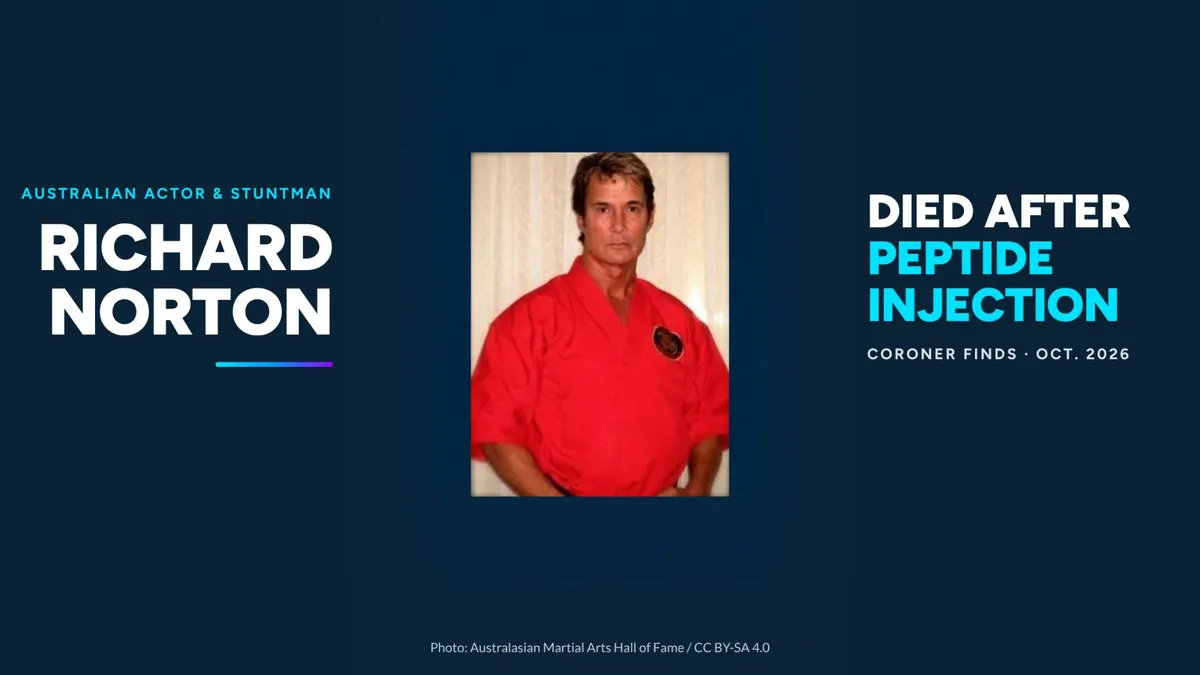
Australian Actor Richard Norton Had a Prescription, a Consent Form and a Licensed Pharmacy. A Coroner Says Unapproved Peptides Still Triggered His Death.
By Kate Dee, MD — Founder, MedSpa Board
On October 28, 2026, a coroner in Victoria, Australia found that the death of actor and martial artist Richard Norton was “triggered by” his injection of two unapproved peptides, CJC1295 and ipamorelin. Norton, 75, spent decades as a stuntman, fight choreographer and actor, worked alongside Chuck Norris and Jackie Chan, and played the Prime Imperator in Mad Max: Fury Road. He collapsed after an injection, went into cardiac arrest, and died at Melbourne’s Alfred Hospital on March 30, 2025.
Coroner David Ryan found that the injection caused anaphylaxis, a severe allergic reaction, which led to cardiac arrest. The findings list asthma and hypertrophic cardiomyopathy, a disease that thickens the heart muscle, as contributing factors. ABC News Australia reports that Norton’s death is believed to be the first confirmed fatality in Australia from unapproved peptide use.
That reaction is the risk the FDA and independent scientists have been warning about. CJC1295 and ipamorelin are peptides, short chains of amino acids, and the FDA has flagged both for immunogenicity: the potential to provoke an immune response against the peptide itself. It is one of the main safety concerns the FDA has cited about these peptides.
Here is what that means. The immune system can learn to recognize an injected peptide as foreign and make antibodies against it. Sometimes those antibodies simply neutralize the peptide, and it stops working. But sometimes the peptide itself becomes a target, and a later injection sets off a massive immune overreaction. In its most severe form, that overreaction is anaphylaxis: the airways narrow, blood pressure collapses, and the heart can stop.
This is not a contamination problem. A sterile, correctly labeled, perfectly pure vial can do this, because the trigger is the peptide and the body’s own response to it. Norton had used peptides before, prescribed by another practitioner, and nothing in the reporting on the coroner’s findings points to a contaminated or mislabeled product.
The same day, in Washington, the Department of Health and Human Services announced that it will let U.S. pharmacies compound six other unapproved peptides.
Norton did not order a gray-market vial from a website. His peptides came through every channel a medspa owner would point to as proof of doing it right. And it still ended in a cardiac arrest.
Prescribed, compounded and consented: Norton’s peptides came through a reputable compounding pharmacy
In March 2025, Norton went to a Melbourne doctor, Jerzy Muchnicki, asking about peptide therapy. He had asthma, osteoarthritis and two reconstructed shoulders, and he told the doctor another practitioner had already prescribed him peptides for fatigue, slow recovery, shoulder pain and loss of muscle.
According to the coroner, the doctor reviewed his medical history and “discussed in detail what was involved with peptide therapy, including the experimental nature of the treatment,” along with the potential risks and the lack of approved alternatives. He ordered baseline blood tests. Norton signed an “Informed Consent Form for Peptide Therapy.” USA Today reports that the form listed anaphylaxis among the possible risks. The peptides were compounded for him by a licensed compounding pharmacy in Queensland.
A prescription. An exam. Labs. A signed consent form naming the exact reaction that led to his death. A licensed pharmacy. Every safeguard a peptide clinic would put in its marketing was there.
Double the prescribed dose, and a nurse’s warning hours before he collapsed
In the days before his death, Norton told the clinic he was feeling good and the peptides were improving his symptoms. He also told a nurse there that he had been injecting double his prescribed dose. According to the coroner, the nurse advised him that “from the following week he ought to only administer the prescribed dose.”
Hours after that conversation, he injected another dose and became unresponsive.
Patients who feel a drug working take more of it, often more than prescribed. That is predictable, and it is exactly why self-injected, unstudied drugs are dangerous. There is no approved dose for CJC1295 or ipamorelin and no studied safe maximum. When a patient doubles the dose, no one, including the prescriber, can say what that means, because no one has studied it.
The prescriber was cautioned over “sparse, inadequate and perfunctory” notes
After Norton died, Australia’s health practitioner regulator received a notification raising concerns about his treatment. The Medical Board of Australia investigated and obtained a report from clinical professor Alistair Vickery, who wrote: “There is insufficient evidence that CJC1295/Ipamorelin is safe, effective or beneficial for human use.”
Vickery concluded that, given the doctor’s training, the written consent, and Norton’s earlier peptide use without problems, the clinical care was “at a standard reasonably expected.” But he called the doctor’s notes “sparse, inadequate and perfunctory” and found his performance below the expected standard on that issue. In July 2026 the board found that the doctor’s practice “is or may be unsatisfactory,” cautioned him, and imposed conditions on his practice.
That is a doctor who did more than most peptide prescribers in this industry, and he still ended up with a caution and conditions on his license.
The coroner also recommended that Australia’s Therapeutic Goods Administration review the benefits and risks of peptides like CJC1295 and ipamorelin and “consider whether further restrictions ought to be imposed on their use.” The TGA says it is considering whether further measures are appropriate.
The FDA flagged immune reactions to both peptides years ago
Neither peptide is approved in Australia or the United States. The FDA lists ipamorelin among bulk drug substances that raise significant safety concerns. It warns that compounded ipamorelin “may pose risk for immunogenicity for certain routes of administration,” and cites a published study that “identified serious adverse events including death when ipamorelin was administered intravenously.” For CJC-1295, the FDA cites the same immunogenicity concern, along with “serious adverse events associated with CJC-1295 including increased heart rate and systemic vasodilatory reaction,” a sudden widening of blood vessels throughout the body that drops blood pressure.
Norton died of that risk at its most extreme.
In December 2024, the FDA’s Pharmacy Compounding Advisory Committee voted 13 to 0 against adding CJC-1295 to the list of substances pharmacies may use in compounding, and 12 to 1 against its acetate form. Neither CJC-1295 nor ipamorelin is FDA-approved, neither is on the 503A bulks list, and neither is covered by the policy HHS announced this week.
The same day, HHS let U.S. pharmacies compound six other unapproved peptides
On October 28, HHS announced a policy of enforcement discretion for compounding six peptides: BPC-157, TB-500, KPV, MOTS-c, Semax and Epitalon. These are the six that the FDA’s advisory committee recommended in July, over the objections of the FDA’s own scientists. The notice was published in the Federal Register on October 30, with a two-week comment period.
The policy comes with conditions. Ingredients must come from an FDA-registered manufacturer following good manufacturing practice. Each batch needs a certificate of analysis covering identity, purity, potency and contaminants such as endotoxin and heavy metals. Each product may contain one peptide, for a specific patient, on a prescription, by a limited set of routes for each peptide, labeled as a compounded drug. Serious adverse events must be reported to the FDA.
HHS itself says the policy “does not grant FDA approval or establish clinical safety and effectiveness.” It does not add these peptides to the 503A bulks list, and HHS can withdraw it if a safety signal appears. We covered what this kind of policy does and does not do when it was still under White House review, in our post “Peptides Are Not Being Approved. They May Be Allowed. That Is Not the Same Thing.”
A clean vial does not make an unstudied drug safe
The HHS conditions address a real problem: what is in the vial. Gray-market peptides are routinely mislabeled, misdosed and contaminated, and a pharmaceutical-grade supply would be safer than what many people are injecting today.
But look at what Norton had. His peptides were compounded by a licensed pharmacy, for him by name, on a doctor’s prescription, after an exam and a consent discussion. The danger was the peptide itself, and how it was used.
Testing tells you what is in the vial. It cannot tell you how a body will react to a drug that has never been through controlled human trials, what dose is safe, what happens at twice that dose, or which patients, such as a 75-year-old with asthma and a thickened heart muscle, should never receive it. Those answers come from clinical studies, and no one is running them for these peptides.
CJC-1295 and ipamorelin have no legal pathway, and the six are still unapproved
CJC-1295 and ipamorelin are unapproved drugs with no pathway for a 503A pharmacy to compound them, and the new HHS policy does not cover them.
The six peptides covered by the HHS policy are still not FDA-approved. They cannot be advertised or described as “approved,” “cleared” or “now legal,” and it is illegal to advertise that they treat or cure anything.
A word of caution: Anyone prescribing peptides in the United States is taking a risk with their own license. Peptides such as these are not FDA approved and are definitely not within the standard of care. Document as if a medical board will read the chart, because after an adverse event it will.
State law still applies, whatever the FDA or HHS decides. State boards of medicine, nursing and pharmacy govern who may prescribe, compound, dispense and administer, and several have already warned licensees about unapproved peptides. If you practice in more than one state, check each one.
Patients: Ask these questions before anyone hands you a peptide syringe
Is this drug FDA-approved? If it is not, ask why it is being prescribed.
Is it CJC-1295 or ipamorelin? Neither is approved, and neither is covered by the new federal policy.
Which pharmacy made it, and is your name on the label? Does it say “research use only” anywhere?
What dose was prescribed? Do not change it without talking to the prescriber. More is not better with a drug no one has studied.
Do you have asthma, a heart condition, or a history of allergic reactions? Tell the prescriber, and ask what is known about this drug in people like you. Often the answer is nothing.
Know the signs of allergic reaction, including anaphylaxis: trouble breathing, swelling of the face or throat, hives, dizziness or fainting. If they appear after an injection, call 911.
Look up the prescriber’s license on your state board’s website. Look up the medical director’s license too.
The MedSpa Board’s position on peptides has not changed this week
The MedSpa Board certifies practices on licensing, medical oversight, and the products and devices they use. Our position on peptides did not change with this week’s HHS policy: until there is real clinical data, their use remains outside the standard of care. A licensed pharmacy and a signed consent form did not change that for Richard Norton.
If you run a medspa and your standards are ready to be verified, begin your application now. If you want to see where you stand first, download our free checklist that tells you all the requirements to become certified.
— Kate Dee, MD
Sources & further reading
- Caitlyn Gribbin and Rachel Carbonell, “Coroner recommends TGA review peptide restrictions after Australian actor’s death,” ABC News (Australia), October 29, 2026. https://www.abc.net.au/news/2026-10-29/victoria-peptide-death-coroners-report-richard-norton/107320590
- “‘Mad Max’ actor Richard Norton died after peptide injection, coroner finds,” USA Today (via Yahoo), October 2026. https://www.yahoo.com/entertainment/celebrity/articles/mad-max-actor-richard-norton-194035372.html
- “Richard Norton Cause of Death: Coroner Says ‘Mad Max’ Star Injected Double His Prescribed Dose of Peptides,” Men’s Journal, October 29, 2026. https://www.mensjournal.com/news/richard-norton-cause-of-death-coroner-peptides
- NBC News, “Richard Norton, actor and martial artist, died after peptides triggered heart attack,” October 2026. https://www.nbcnews.com/pop-culture/pop-culture-news/richard-norton-actor-martial-artist-died-peptides-triggered-heart-atta-rcna606555
- U.S. Food and Drug Administration, “Certain Bulk Drug Substances for Use in Compounding that May Present Significant Safety Risks” (content current as of April 22, 2026). https://www.fda.gov/drugs/human-drug-compounding/certain-bulk-drug-substances-use-compounding-may-present-significant-safety-risks
- U.S. Food and Drug Administration, Pharmacy Compounding Advisory Committee, Final Summary Minutes, December 4, 2024 meeting. https://fda.gov/media/185642/download
- Foley & Lardner, “Peptides: HHS Announces Limited Enforcement Discretion for Compounding of Six Peptides,” October 2026. https://www.foley.com/insights/publications/2026/10/peptides-hhs-announces-limited-enforcement-discretion-for-compounding-of-six-peptides/
- AJMC, “HHS Draft Policy Eases Enforcement on 6 Compounded Peptides,” October 29, 2026. https://www.ajmc.com/view/hhs-draft-policy-eases-enforcement-on-6-compounded-peptides
- ABC News (U.S.), “Some wellness peptides will become widely available, HHS says,” October 28, 2026. https://abcnews.com/Health/wellness-peptides-become-widely-hhs/story?id=137650076
- The MedSpa Board, “Peptides Are Not Being Approved. They May Be Allowed. That Is Not the Same Thing,” October 2026. https://blog.medspaboard.com/post/peptides-not-approved-may-be-allowed
- The MedSpa Board, “‘Research Use Only’ Is Not a Loophole. Where Peptides Stand Right Now,” October 2026. https://blog.medspaboard.com/post/research-use-only-peptides-not-a-loophole
- Thumbnail photo of Richard Norton: Australasian Martial Arts Hall of Fame, licensed under CC BY-SA 4.0 (https://creativecommons.org/licenses/by-sa/4.0/). https://commons.wikimedia.org/w/index.php?curid=59029758