
Two Saline Recalls in Two Weeks. Have You Checked Your IV Bags?
By Kate Dee, MD — Founder, MedSpa Board
In the last week of August 2026, two of the largest IV fluid manufacturers in the country recalled lots of 0.9% Sodium Chloride Injection, USP. That is plain normal saline, the most basic product in any IV therapy room. Baxter recalled two lots of its 500 mL bags after finding particles identified as fiberglass in the solution. B. Braun recalled three lots of its 100 mL bags after finding iron oxide, inorganic, cellulose, and polystyrene particulate matter.
Neither notice mentions medical spas. Both products were distributed to hospitals, healthcare facilities, and distributors, which is exactly how most medspas and IV clinics buy their fluids. If your practice offers IV hydration, vitamin infusions, or anything else that runs through a saline bag, you need to check your lot numbers this week. Not next month, not at your next inventory. This week.
We recently reported about contamination of glutathione (compounded from a supplement-grade ingredient) and now it is the IV bag itself. The IV therapy business has been built on the assumption that whatever arrives in the box is safe to hang. That assumption is not a safety system.
What was recalled
Everything below comes from the manufacturers’ recall notices as posted by the FDA. A recall is a safety action, not a finding that anyone was harmed, and both companies report no adverse events tied to these lots so far.
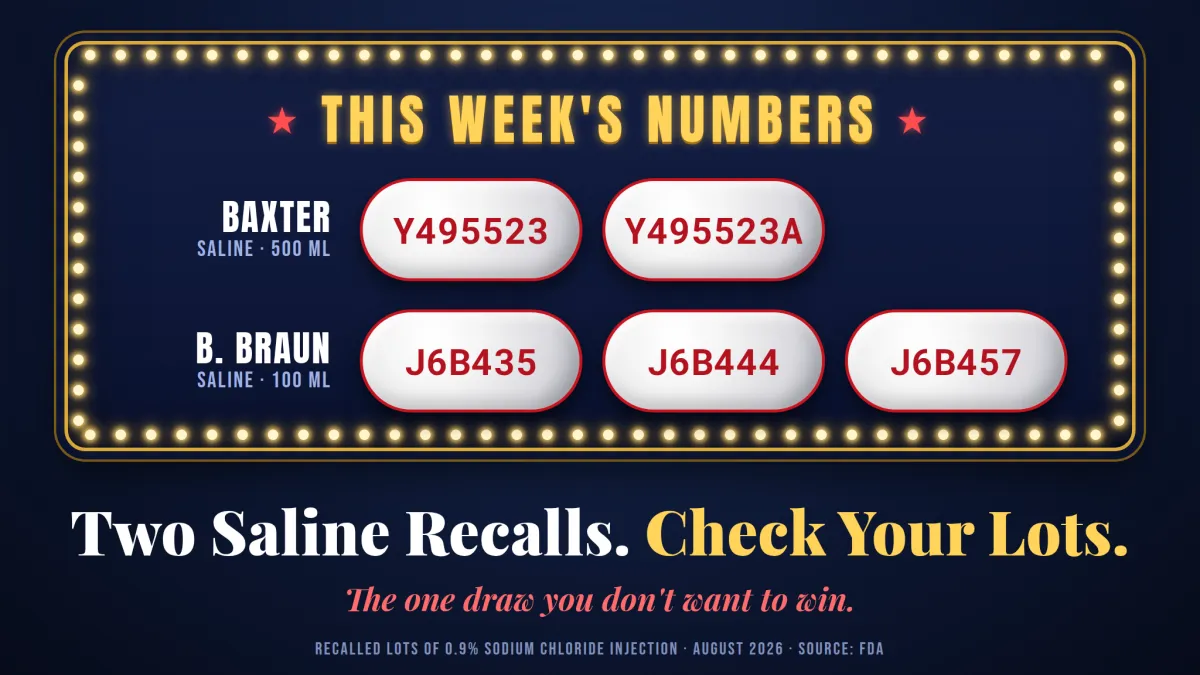
Baxter, announced August 25, 2026. 0.9% Sodium Chloride Injection, USP, 500 mL VIAFLEX plastic container, NDC 0338-0049-03. Lots Y495523 and Y495523A, expiration October 31, 2027. The reason: “the potential presence of particulate matter identified as fiberglass in the solution.” The product shipped July 31 through August 3, 2026, to healthcare providers and distributors in 14 states: Florida, Illinois, Indiana, Louisiana, Maryland, Missouri, New Jersey, Nevada, New York, North Carolina, Ohio, South Carolina, Texas, and Virginia.
B. Braun, company notice dated August 19, 2026, posted by the FDA in late August. 0.9% Sodium Chloride Injection USP, 100 mL in a 150 mL PAB container, NDC 0264-1800-32, catalog S8004-5264. Lots J6B435, J6B444, and J6B457, all expiring April 30, 2027. The particulates were identified as iron oxide, inorganic material, cellulose, and polystyrene. This product shipped nationwide between February 27 and August 3, 2026, which means it has had six months to make its way onto shelves.
One detail matters if you are getting your information from the news. B. Braun’s recall was first circulated as zinc oxide contamination. On August 28 the FDA notice was updated to say the firm had corrected the particulate to iron oxide. Much of the coverage still says zinc. Unfortunately sometimes the headlines are inaccurate. It's important to be on top of all FDA and recall notices.
Why particles in a bag matter
Anything swallowed has to get past the digestive tract before it reaches the bloodstream. Anything in an IV bag goes straight into a vein, then to the heart, then to the lungs. The lungs are the first filter a particle meets, and that is where it tends to lodge.
B. Braun’s notice says its product “has a reasonable probability of causing life-threatening adverse health consequences including pulmonary emboli, occlusions of other blood vessels, and/or phlebitis,” along with immune activation, organ dysfunction, and hemolysis (the destruction of red blood cells). Baxter lists vessel blockage, pulmonary embolism, organ damage, and death, along with vein irritation, inflammatory reactions, and allergic reactions.
These are hospital-grade risks attached to a product that medspas and IV bars hang every day, often for patients who have no medical reason to be receiving an infusion at all.
What to do this week if you offer IV therapy
Check every bag of 0.9% sodium chloride. That includes the stockroom, the treatment rooms, and any mobile or concierge kits. Match the manufacturer, the bag size, the NDC, and the lot number against the list above. Size matters: the Baxter lots are 500 mL VIAFLEX bags and the B. Braun lots are 100 mL bags in a 150 mL PAB container.
If anything matches, stop. Pull it, quarantine it, label it “recalled — do not use,” and follow the manufacturer’s instructions. Baxter asks facilities to discontinue use immediately and return affected units; contact Baxter Healthcare Center at 888-229-0001. B. Braun asks customers to return product to the place of purchase and is arranging replacement; contact [email protected].
Find out whether any recalled bags were already used. This is where your infusion records either protect you or expose you. If you record the lot number of every bag you hang, you can identify exactly which patients received it. If you do not, you cannot, and that is a problem you will have to explain to your medical director, your malpractice carrier, and potentially your state board.
If a recalled lot was infused, tell your medical director today. Review those patients’ charts, reach out to them, and document what you did. Report any adverse event to FDA MedWatch at 1-800-332-1088 or online.
Inspect every bag before use. Look for particles, cloudiness, discoloration, and leaks, and set the bag aside if anything looks wrong. Visual inspection will not catch everything, and it is no substitute for checking lot numbers, but it costs nothing.
Make sure you will actually hear about the next recall. Recall notices go out through the supply chain. Confirm that your supplier has a current contact on file for recall notices, assign one person on your staff to own recall checks, and sign up for FDA recall email alerts. A spa that found out about this recall from Instagram has a supply chain problem.
What legitimate IV sourcing looks like
Here is the uncomfortable part. A recall check only works if you know where your fluids came from. If your bags came from an online marketplace, from another practice down the street, or from a reseller you cannot name, you cannot run this check with any confidence, and the lot number on the bag tells you nothing about how it was stored or handled before it reached you.
0.9% Sodium Chloride Injection is a prescription drug. Under federal law, the Drug Supply Chain Security Act requires the businesses that buy and sell prescription drugs to deal only with authorized, properly licensed trading partners. Buying outside that chain is not a gray area. It is a legal compliance problem, and it is not limited to fake clinics. Licensed providers cut these corners too, usually in pursuit of a lower price per bag.
The MedSpa Board IV Infusion Therapy Standard is direct about this. Certified practices must:
Purchase IV bags, medications, and additives only from licensed medical suppliers, manufacturers, or appropriately licensed compounding pharmacies.
Document sourcing, storage, lot numbers, expiration dates, and beyond-use dates.
Keep a complete record of every infusion, including the product, its source, and its lot and expiration data.
Document and review product and sourcing concerns, and pause or discontinue any IV offering when sourcing requirements cannot be met.
If you are a patient
Before your next IV, ask. Who makes the fluids and additives you use, and where do you buy them? Do you record the lot number of the bag I receive? Who is your medical director? (Look them up.) Is the person starting my IV licensed to do it? (Look them up too.) And why do I need this infusion? If there is no medical reason, there is no reason to accept the risk.
If you have had an IV recently and develop sudden shortness of breath, chest pain, a cough with blood, or a racing heart, seek emergency care. Pain, redness, warmth, or swelling along the vein where the IV was placed also warrants a call to your provider.
What we do not know yet
Neither company has said publicly how the particles got into the bags, and the two recalls involve different companies, products, and manufacturing sites. Neither notice says how many bags reached outpatient clinics, medspas, or IV bars, and no adverse events have been reported. We do not know whether more lots will follow.
What we do know is that the IV fluid supply is less resilient than most clinics assume. When Hurricane Helene shut down Baxter’s North Cove plant in North Carolina in the fall of 2024, the country lost its largest source of IV solutions, and the FDA did not take sodium chloride 0.9% off its shortage list until August 2025. During that shortage the CDC asked facilities to use oral hydration where appropriate and to question whether IV fluids were clinically necessary. That is a good question to ask every day, not only during a shortage.
Where MedSpa Board certification fits
No certification can stop a manufacturing defect in a sealed bag. That is the manufacturer’s responsibility, and in this case both companies caught the problem and recalled the product. But this recall should prompt a more basic question than which lot is sitting on your shelf: why is the bag being hung at all?
Every IV is a medical procedure with medical risks. Placing a line in a vein carries a risk of infection, infiltration, and phlebitis, and anything added to the bag can trigger an immediate reaction, including anaphylaxis. Those risks can be justified when an infusion treats a documented medical problem. They cannot be justified when the reason is a hangover, a “wellness boost,” or an item on a drip menu. If there is no legitimate medical reason for an IV, it should not be ordered in the first place.
The MedSpa Board IV Infusion Therapy Standard is built on that principle. Every infusion requires a documented clinical indication and a patient-specific order from a licensed prescriber. Every patient requires a good faith exam by a physician, nurse practitioner, or physician assistant. Every infusion requires in-person monitoring, with emergency equipment and medications on site. The standard also prohibits marketing IV therapy with unsupported claims like “immunity boost” or “performance enhancer.” A walk-in drip bar that sells infusions off a menu is not built to meet that standard, and The MedSpa Board is not in the business of lending that model a badge.
For medical practices that offer IV therapy only when it is medically indicated, and that can show us the order, the exam, the source of every bag, and which patient received which lot, certification lets you prove it before anyone asks. For patients, it is the difference between hoping and knowing what is going into your vein. Trust, verified. Safety, certified.
If you run a legitimate medical practice and your standards are ready to be verified, begin your application at medspaboard.com/certification-application. If you want to see where you stand first, download the free certification-checklist.
— Kate Dee, MD
Sources & further reading
- U.S. Food and Drug Administration, “Baxter Issues Voluntary Nationwide Recall for Two Lots of 0.9% Sodium Chloride Injection Due to Potential Presence of Particulate Matter,” company announcement August 25, 2026. https://www.fda.gov/safety/recalls-market-withdrawals-safety-alerts/baxter-issues-voluntary-nationwide-recall-two-lots-09-sodium-chloride-injection-due-potential
- U.S. Food and Drug Administration, “B. Braun Medical Inc. Issues Voluntary Nationwide Recall of 0.9% Sodium Chloride Injection USP, 100 mL, in a 150 mL PAB® Container Due to the Presence of Particulate Matter,” 2026. https://www.fda.gov/safety/recalls-market-withdrawals-safety-alerts/b-braun-medical-inc-issues-voluntary-nationwide-recall-09-sodium-chloride-injection-usp-100-ml-150
- American Hospital Association, “FDA issues recall alerts for certain convenience kits; companies voluntarily recall certain IV fluids,” August 28, 2026. https://www.aha.org/news/headline/2026-08-28-fda-issues-recall-alerts-certain-convenience-kits-companies-voluntarily-recall-certain-iv-fluids
- Medical Daily, “Hospital IV Saline Was Recalled for Zinc Oxide Particles, Then the Company Corrected It to Iron Oxide,” 2026. https://www.medicaldaily.com/b-braun-sodium-chloride-injection-recall-iron-oxide-particulate-478008
- Medical Daily, “Two IV Saline Recalls Within Days Cite Iron Oxide and Fiberglass Particles Found Inside Sealed Hospital Bags,” September 4, 2026. https://www.medicaldaily.com/baxter-b-braun-sodium-chloride-injection-recalls-particulate-matter-478246
- iSKY News, “FDA: Saline Bags Recalled Nationwide Over Particles That Could Cause Life-Threatening Complications,” September 2026. https://www.iskynews.com/2026/09/fda-saline-bags-recalled-nationwide.html
- Centers for Disease Control and Prevention, “Shortage of IV and Peritoneal Dialysis Solutions,” October 2024. https://www.cdc.gov/healthcare-associated-infections/bulletins/shortage-of-iv-and-peritoneal-dialysis-solutions.html
- Axios, “FDA says IV fluid shortage from hurricane is over,” August 12, 2025. https://www.axios.com/2025/08/12/iv-fluid-shortage-fda-ends
- U.S. Food and Drug Administration, Drug Supply Chain Security Act (DSCSA). https://www.fda.gov/drugs/drug-supply-chain-integrity/drug-supply-chain-security-act-dscsa
- U.S. Food and Drug Administration, MedWatch: The FDA Safety Information and Adverse Event Reporting Program. https://www.fda.gov/safety/medwatch-fda-safety-information-and-adverse-event-reporting-program
- MedSpa Board, certification standards and application. https://medspaboard.com/certification-application/