Black Mold, Insects and Samples Poured Into Sinks: FDA Inspected Two Chinese Factories Supplying Compounded GLP-1 Ingredients
By Kate Dee, MD — Founder, MedSpa Board
Every vial of compounded semaglutide or tirzepatide in a medspa refrigerator has a pharmacy label on it. It tells you what pharmacy compounded the drug — it does not tell you where the ingredients came from.
The active ingredient, the peptide itself, arrives at the pharmacy as a bulk powder, and a large share of it is made in China. In August and September 2026, FDA inspectors visited two Chinese companies that make semaglutide and tirzepatide ingredient for the compounding market in the US. What they found at one plant was black mold on equipment, insects in the ceiling, and staff pouring product samples into sinks during the inspection. At the other, workers were buying ingredient made by other factories and stamping it with their own approval.
The FDA has placed both companies on import alert, which allows U.S. border officials to stop their shipments. The findings were first reported by Bloomberg on October 15, 2026, from inspection reports the news service obtained through a Freedom of Information Act request.
Neither report names a U.S. pharmacy that bought from these companies, and nothing published so far shows that a specific finished product in the United States was contaminated. That is exactly the problem. Most medspas selling compounded GLP-1s could not tell you whether their pharmacy bought from either plant, because they have never asked where the ingredient comes from.
Chengdu Shengnuo Biopharm, August 2026: black mold, insects and samples poured into sinks
Chengdu Shengnuo Biopharm is in southwest China. When FDA inspectors arrived in August, according to Bloomberg’s account of the inspection report, they found black mold on manufacturing equipment, “gross contamination” on floors, and “significant insect activity” in ceiling areas.
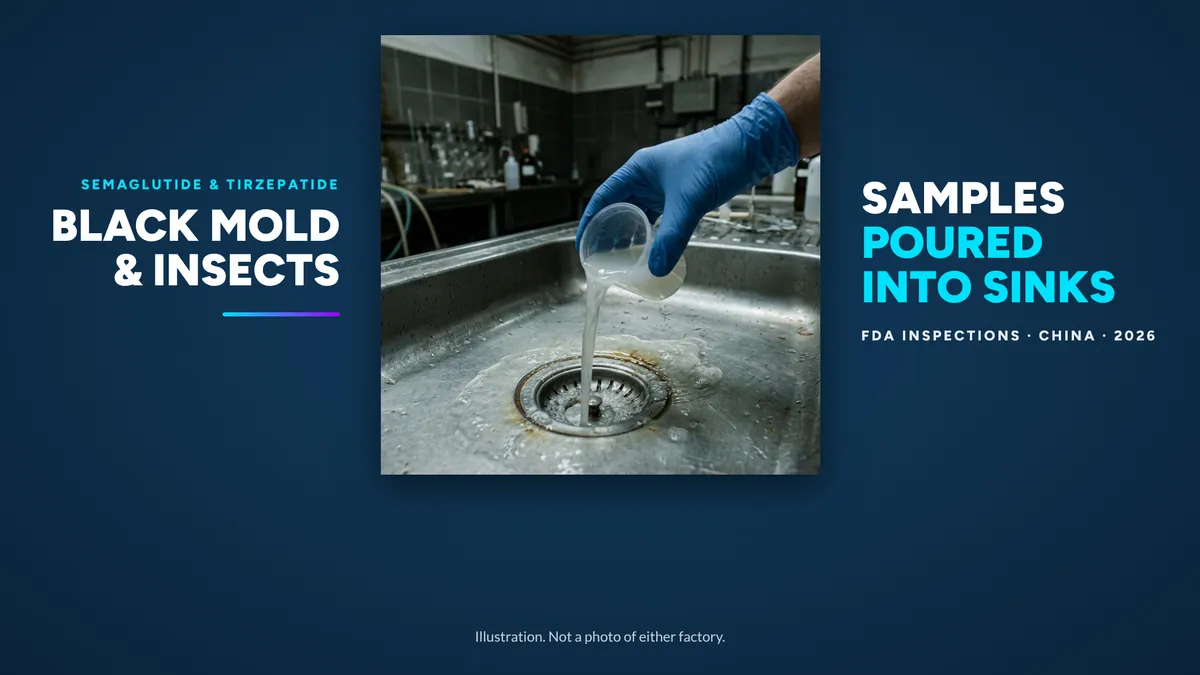
The conduct was worse than the conditions. Quality control staff moved documents out of the laboratory and stuffed them into lockers in another room. Inspectors were not able to recover all of them. Personnel were also seen pouring product samples into sinks “in a seemingly coordinated effort.”
Quality control is the department whose entire job is to prove the product is what the label says. At this plant, that department was hiding records and destroying samples while the FDA watched.
The plant had last been inspected in September 2023. In a Chinese regulatory filing, the company said it has been “diligently implementing effective measures” to fix the problems. It did not respond to Bloomberg’s requests for comment.
Nanjing Chengong, September 2026: other factories’ ingredient, stamped with its own approval
Nanjing Chengong Pharmaceutical is on China’s east coast. In September, inspectors found workers buying active ingredient made by other factories and applying Nanjing Chengong’s own approval seal to it. Staff did not review the other factories’ test data to confirm the ingredient was safe.
Think about what that means downstream. A pharmacy buying from Nanjing Chengong would receive paperwork with Nanjing Chengong’s name on it, for ingredient Nanjing Chengong did not make and did not verify. The certificate of analysis looks fine. The name on it is not the factory that made the powder.
Nanjing Chengong is not a small player. A 2025 Brookings Institution analysis named its parent company, Nanjing Hanxin, as a large supplier of GLP-1 ingredient. The plant had last been inspected in March 2025. California-based Amphastar Pharmaceuticals holds an 11.5% minority stake in Nanjing Hanxin and told Bloomberg it does not control or manage those operations.
Michael Rogers, a former FDA associate commissioner for inspections and investigations, told Bloomberg the findings “suggest a serious accident waiting to happen.”
The FDA found one in five GLP-1 ingredient makers it evaluated out of compliance
These two plants are not outliers the FDA stumbled on by chance. In September 2025, the agency created what it calls a “green list” import alert, Import Alert 66-80, for GLP-1 bulk ingredients. Ingredients from manufacturers the FDA has inspected or evaluated and found compliant can come into the country. Ingredients from anyone else can be detained at the border without examination.
In its October 2026 revision of that alert, the FDA reported that of the 48 GLP-1 ingredient sites it evaluated, 21% were noncompliant. One in five.
The FDA is also tracking harm from the finished products. As of May 31, 2026, the agency had received 990 adverse event reports involving compounded semaglutide and more than 730 involving compounded tirzepatide. The FDA notes these numbers likely undercount the problem, because state-licensed 503A pharmacies are not required to report adverse events at all.
A pharmacy’s sterile room cannot fix a contaminated raw ingredient
The usual reassurance from medspas is that the drug comes from a licensed compounding pharmacy with a clean room. The clean room matters. It is also the last step in a long chain.
Sterile filtration removes bacteria and mold spores. It does not remove bacterial endotoxins, chemical impurities, degraded peptide, or the wrong substance. If the powder going into the compounding process is impure or is not what the paperwork says, the pharmacy produces a sterile vial of the wrong thing.
The FDA says this directly in the import alert. Compounders whose drugs meet the conditions of section 503A are exempt from current good manufacturing practice requirements, so quality problems with the bulk ingredient “may not be controlled or monitored during compounding.” In other words, many 503A pharmacies are relying on the supplier’s paperwork. At Nanjing Chengong, the paperwork was the problem.
We have seen what happens when compounding goes wrong at scale. In 2012, contaminated steroid injections from the New England Compounding Center caused a fungal meningitis outbreak that infected more than 700 people and killed 64. That disaster is the reason Congress tightened oversight of compounding. It did not make the global ingredient supply chain any easier to see.
Same price, same label, and no way to tell which pharmacy used a tainted factory
The compounded GLP-1 business in wellness and weight loss clinics grew fast. The shortages ended in 2025, and much of the industry kept going by adding vitamin B12 or another ingredient to call the product something other than a copy. We covered how the FDA views that workaround in our post on its warning letter to Empower Pharmacy.
What these inspections show is how hard it is for a practitioner to know what is in the vial. Nanjing Chengong put its own approval seal on ingredient made by other factories. Chengdu Shengnuo hid records and poured out samples during an FDA inspection. These are suppliers working to deceive the people who buy from them, and the pharmacies buying from them may not have known either.
Price does not sort this out. A cheap vial may come from a questionable source. But two pharmacies can charge the same price for what looks like the same product, and one of them may be compounding with ingredient from a factory like these. The label, the price and the pharmacy’s clean room will all look the same. Nothing published so far names which U.S. pharmacies bought from either plant.
This is buyer beware, and the buyer is the practitioner. Licensed physicians, nurse practitioners and PAs, many of whom know these drugs well and prescribe them carefully, have reasonably assumed that a licensed pharmacy checks its ingredient. These inspections are a reason to stop assuming and start asking.
The prescriber’s name is on the prescription. The medical director is responsible for what the practice puts into patients. “The pharmacy handles that” is not an answer a medical board will accept if a patient is harmed.
Medspa owners: Get your pharmacy’s answer on its semaglutide and tirzepatide supplier in writing
Federal law already sets a floor. A 503A pharmacy may compound only with bulk drug substances made by an FDA-registered establishment and accompanied by a valid certificate of analysis. Registration is not the same as passing an inspection, and as Nanjing Chengong shows, a certificate is only as good as the company that signs it. So ask more.
Ask, in writing, who manufactured the semaglutide or tirzepatide ingredient in the lots you received. The actual manufacturing site, not a broker or distributor.
Ask whether that manufacturer is on the FDA’s GLP-1 green list, Import Alert 66-80. The public version of the list has the company names redacted, so you will need the pharmacy to confirm it.
Check the manufacturer against Import Alert 66-40, the FDA’s public “red list” of foreign drug makers that have not met manufacturing standards. You can search it yourself.
Ask whether the pharmacy ever bought from Chengdu Shengnuo Biopharm, Nanjing Chengong Pharmaceutical, or Nanjing Hanxin, directly or through a broker.
Ask for the certificate of analysis for each lot, and whether the pharmacy does its own identity and purity testing on the ingredient or relies only on the supplier’s paperwork.
Ask for sterility and endotoxin test results for the finished lots you received.
Keep every answer in your files.
If your pharmacy cannot or will not answer these questions, that is your answer.
The rest of the law still applies too. A compounded GLP-1 requires a prescription from a physician, or an NP or PA acting within their scope and any required supervision or collaboration, after a real evaluation of that patient. With the shortages over, a compounded version of an approved drug needs a documented clinical reason for that patient. An RN or an aesthetician cannot prescribe it in any state.
MedSpa Board certification can’t vouch for your GLP-1 ingredient, but you can
The MedSpa Board certifies medspas on licensing, medical oversight, and the products and devices they use, including where those products are purchased. But it is up to you, as an owner or provider, to confirm the quality of your sourcing. A practice that can show who made what it injects is a practice that has done its job. A practice that cannot is relying on a supply chain it has never seen.
If you run a medspa and your standards are ready to be verified, begin your application now. If you want to see where you stand first, download our free checklist that tells you all the requirements to become certified.
— Kate Dee, MD
Sources & further reading
- Edney (Bloomberg), with Ike Swetlitz and Amber Tong, “Black Mold, Bugs Found at Chinese Plants Making GLP-1 Compounding Agents,” republished by DNYUZ from the Los Angeles Times, October 19, 2026. https://dnyuz.com/2026/10/19/black-mold-bugs-found-at-chinese-plants-making-glp-1-compounding-agents/
- NewsBytes, “FDA finds problems at Chinese semaglutide and tirzepatide ingredient factories,” October 16, 2026. https://www.newsbytesapp.com/news/world/fda-finds-problems-at-chinese-semaglutide-and-tirzepatide-ingredient-factories/tldr
- U.S. Food and Drug Administration, Import Alert 66-80, “Detention Without Physical Examination of Glucagon-Like Peptide-1 (GLP-1) Receptor Agonist Bulk Drug Substances” (revised October 9, 2026). https://www.accessdata.fda.gov/CMS_IA/importalert_1186.html
- U.S. Food and Drug Administration, Import Alert 66-40, “Detention Without Physical Examination of Drugs From Firms Which Have Not Met Drug GMPs.” https://www.accessdata.fda.gov/cms_ia/importalert_189.html
- U.S. Food and Drug Administration, “FDA’s Concerns with Unapproved GLP-1 Drugs Used for Weight Loss” (updated October 1, 2026). https://www.fda.gov/drugs/postmarket-drug-safety-information-patients-and-providers/fdas-concerns-unapproved-glp-1-drugs-used-weight-loss
- The MedSpa Board, “Empower Pharmacy is in trouble with the FDA. Is Your GLP-1 Supplier Next?,” October 2026. https://blog.medspaboard.com/post/empower-pharmacy-fda-warning-letter-compounded-glp-1